2026 NCAA CHAMPIONSHIP (WOMEN)
RESULTS
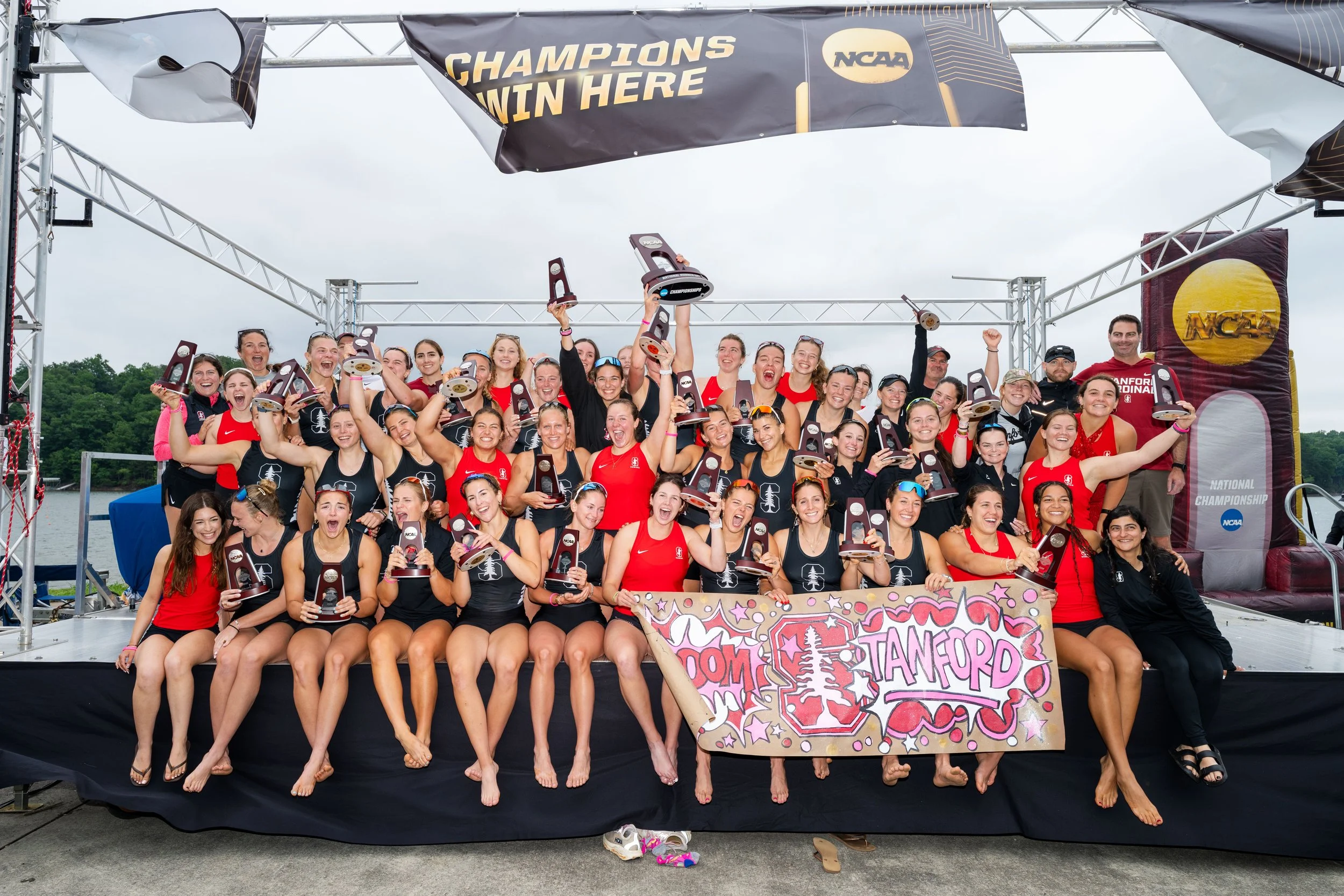
The Stanford Women finished as national runner-up at the 2026 NCAA Championships, extending the program’s streak to six consecutive top-two national finishes and again showing the depth that has defined Stanford women’s rowing over the last several seasons. Texas won the team title with 130 points, Stanford followed with 125, and Tennessee took third with 119. Stanford also continued a remarkable stretch of boat-level success by capturing a fourth straight NCAA title in the 2V8.
This year’s championship also felt like a sign of where elite women’s rowing is headed. The top of the field was exceptionally compressed all spring, and by the time the teams reached Lake Lanier there was no sense of inevitability around any one varsity eight. Stanford had the speed to beat top teams during the season (including Tennessee), Tennessee had defeated Texas at the SEC Championship, and Texas ultimately produced the fastest closing NCAA performance. The days when the top seed could simply roll through a season undefeated may be fading, even if the very best teams are still separating themselves as the most consistent ones over time. That made Stanford’s finish no less impressive, only a reflection of just how high the standard has become. As a point of reference, the Romanian women won the gold medal on the same Lake Lanier course with a 6:19.73 at the 1996 Atlanta Olympics (compare this to the results further down this email!). And, while there was a bit of a tailwind at NCAAs, making times a bit faster than usual, it is still remarkable how close women’s collegiate rowing has come to the elite level.
Stanford handled a complicated championship setup well from the start. Because thunderstorms were forecast for Saturday, heats and semifinals were compressed into a single Friday, and the Cardinal adjusted cleanly. The conditions also produced extraordinary speed all weekend. All three NCAA championship records ultimately fell on Sunday in the 1V8, 2V8, and 1V4, and the coaches noted afterward that some of those marks even dipped into world-best territory, though they would not count officially outside a World Rowing event using its timing system. All three Stanford boats won their heats, with the varsity four posting the fastest heat time of the entire Division I field at 6:44.712 and the largest margin of victory among the Division I heats. The varsity four’s heat was described afterward as nearing world-record pace as it cruised to a nearly 14-second win over Brown. The 2V jumped out early and held open water to win its heat by five seconds over Brown, while the 1V beat Virginia by about five seconds and broke six minutes in the process. In the semifinals, Stanford advanced all three boats to the Grand Finals, joining only Texas, Tennessee, and Virginia in putting all NCAA boats into Sunday’s championship races. The staff’s emphasis on recovery between rounds clearly mattered, and the team’s ability to pivot on short notice was one of the quieter strengths of the weekend.
That adaptability was a real part of the story. No strangers to changes on the fly, the Stanford rowers handled the adjusted schedule well and prioritized their recovery midday in preparation for the semifinal round. The coaches credited athletic trainers Sanam Rezazadeh and Steve Moshinger for their recovery guidance and soft tissue work, helping prepare the athletes for two rounds of racing in one day.
Ironically, Saturday itself turned out beautiful. The team was able to get out on the course for a swing row — one final practice before Sunday’s racing — and later enjoyed the company of their non-racing teammates, who flew in from Palo Alto the evening before. Dubbed the “Hype Squad,” this has become a tradition for the team since 2023. The full-team presence, the team’s “we before me” mantra, and the alum video messages that have become such a beloved part of the NCAA weekend all felt woven into the way Stanford carried itself at the championship.
Sunday then delivered exactly the kind of ripping conditions that make records vulnerable. The coaches knew it was going to be a record-setting day when boats in the C finals were already breaking 6:00. Stanford opened with a painful but valiant 1V4 race. The boat was in first place into the last 250 meters before a crab in the choppy tailwind dropped the Cardinal to fifth in 6:52.518. While a disappointment for sure, we all know this can happen in any elite race (see the Cal men’s 1V8 in the 2025 IRA semis, and UW men’s 1V8 in the 2024 Henley finals), and we are proud of their resilience to get over the finish line. And, as it turned out, this did not have an impact on the NCAA final team standings.
The 2V8 then answered in emphatic fashion, winning wire to wire in 5:52.905 and breaking the NCAA Championships record by more than 18 seconds. The previous record had been 6:11.26 by Washington in 2019. The 1V8 closed the regatta with a gutsy second-place finish, surging late but unable to fully reel Texas back in after the Longhorns made their decisive move in the third 500.
The way each finals race developed also reflected a lot of what the coaches emphasized afterward. The 1V8 was fourth at the first 500 in a tightly packed field, then closed the gap on Texas in the second 500 to come within 0.7 seconds. Texas used a powerful third 500 to stretch to about a length, and Stanford’s late surge was not quite enough to erase it. The 2V8, meanwhile, capped the season with a wire-to-wire win despite a late push by Texas. And while the 1V4 result was heartbreaking, the larger view is still one of pride in an incredibly valiant and record-setting season for that crew.
There was also a deeply human side to the weekend that felt unmistakably true to this team. Race day still began the way it had throughout the year, with a line-dancing session to Footloose led by freshman Emma Bagrie. The alum video tradition returned, the Hype Squad showed up in wigs and tutus, and the non-racing teammates who flew in from Palo Alto brought the same energy and support that have become part of Stanford’s NCAA identity since 2023. The group’s “we before me” mantra was evident everywhere — in the way they handled schedule changes, in the way they recovered between races, and in the way they continued to find joy in the process, even on the sport’s biggest stage.
That is why, even in a result that felt slightly bittersweet, the weekend still sounded unmistakably like Stanford Women’s Rowing. As the coaches put it, it takes courage to allow yourself to set the bar high, and Stanford is fortunate to be in a position where second place can feel this way. That is a reflection of the standard. It is also a reflection of the senior class, whose leadership shaped the team in profound ways. Between the ten seniors, they leave with a collective 22 NCAA medals, including 14 golds, and they leave behind a team identity that one coach summarized as nothing other than: “it’s hard to beat a team that’s having fun, and working hard is the most fun.”
That spirit came through in senior Annika Jeffery’s reflection as well:
“Of course, we would have loved a different result, but this team made it feel like a win. The SWC magic really is something special. We work hard and play hard. Fast is fun, but fun is faster.” She also pointed to the Hype Squad ambushing the team Sunday morning and joining the Footloose dance from the other side of the fence during warmup, calling it a perfect example of how this team finds fun in the seemingly mundane and how much it matters to do it all together.
Stanford’s parents and supporters showed up in force too, something even the commentators noticed. They hosted a post-race barbecue, and senior Carolyn Kennedy remarked how special it was to have “all of her people in the same place at the same time” — family, friends, and teammates’ families alike. Stanford did not leave Lake Lanier with the team trophy this time, but it left with a national runner-up finish, another NCAA boat title, and every reason to believe the program is still very much at the front of the sport.
Stanford Women NCAA Finals Results
1V8 (Grand Final)
Texas – 5:47.706
Stanford – 5:50.160
Tennessee – 5:51.450
Virginia – 5:52.398
Yale – 5:53.412
Princeton – 6:00.056
2V8 (Grand Final)
Stanford – 5:52.905
Texas – 5:54.761
Virginia – 5:58.225
Tennessee – 6:02.917
Princeton – 6:03.119
Yale – 6:05.691
1V4 (Grand Final)
Texas – 6:35.728
Tennessee – 6:41.292
Washington – 6:47.654
Rutgers – 6:48.982
Stanford – 6:52.518
Virginia – 6:52.692
NCAA Team Points
Texas – 130
Stanford – 125
Tennessee – 119
Virginia – 114
Yale – 103
Read the GoStanford writeups here: