2026 IRA CHAMPIONSHIPS (LIGHTS + MEN)
RESULTS
Stanford Women’s Lightweight Rowing – Bronze in the Eight, Fourth as a Team
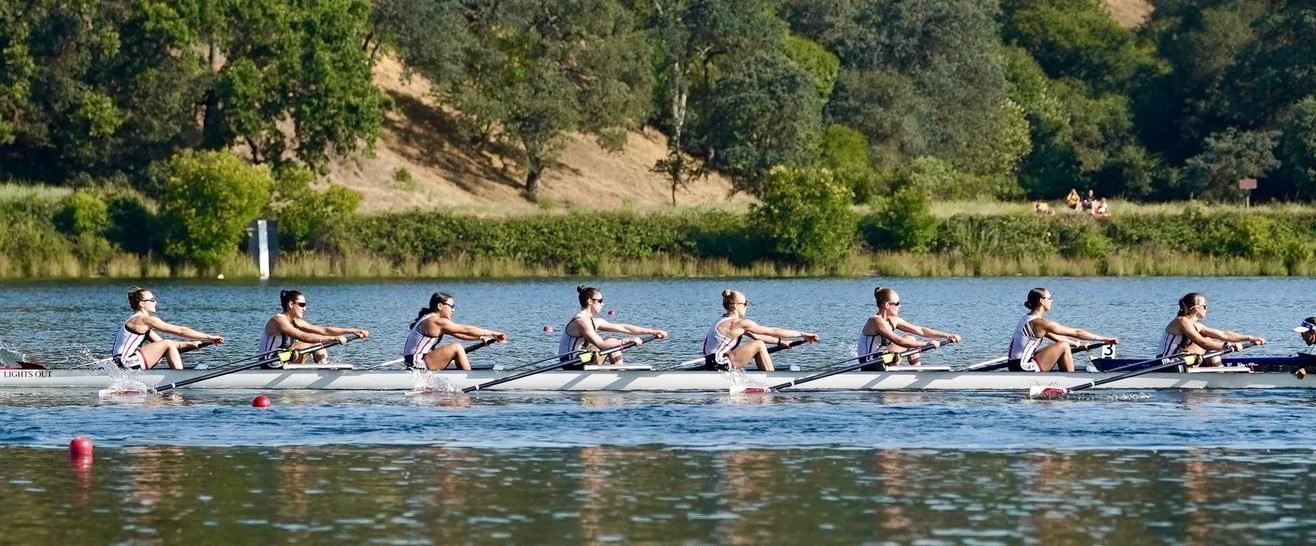
The Stanford Lightweight Women closed their season with one of their best overall championship weekends in several years, finishing fourth in the Commissioner’s Cup standings at the IRA National Championships. That was two places better than last year’s sixth-place finish, and it was driven by a 1V8 that continued its steady year-over-year climb, taking bronze in 6:46.085. Stanford finished behind only Princeton and Radcliffe in the 1V8 and held off Boston University for the medal, another encouraging result after also beating BU the previous weekend.
The momentum building around the Lightweights was evident, especially since the Big Ten Invitational, and it was exciting to see the season finish on that kind of note. All three Stanford boats reached their Grand Finals, and the heats played a major role in making that possible. The strong middle 1,000 meters in each race helped solidify those spots, with especially important qualifying efforts from the 1V4 and the 2x, both of which delivered the kind of heat races the team needed for the overall standings.
That outcome felt especially meaningful because the Lightweights, like the men, have spent the last several years working through the recruiting shadow created by COVID and the near-elimination of the rowing programs. The 1V8 keeps getting faster, but the broader weekend also showed real substance across the roster. The V2x made up a 1.6-second deficit over the second half of its heat to qualify, and the 1V4 worked through early adversity to secure its place in the final as well — exactly the kind of qualifying work that mattered to the overall team finish.
On finals day, the 1V8 delivered the signature performance. Stanford established itself among the top three boats in the opening 500, carried a medal position throughout, and then posted the best closing speed of the top three to hold off a strong Boston University crew by about three seconds. The V2x were also right in the mix, finishing fifth and just 0.143 seconds behind MIT for fourth and 0.938 seconds behind Radcliffe for bronze. The 1V4 came in sixth, and those three grand-final appearances together pushed Stanford to fourth in the team standings with 52 points, behind Princeton, Boston University, and Radcliffe.
Taken as a whole, it was a very strong finish to the season. The bronze medal in the eight was the clearest headline, but the bigger story may be that the entire lightweight squad looks to be moving back toward the top tier of the national conversation.
Stanford Lightweight Women IRA Finals Results
1V8 (Grand Final)
Princeton – 6:40.493
Radcliffe – 6:44.002
Stanford – 6:46.085
Boston U. – 6:49.192
Georgetown – 6:53.917
MIT – 7:00.838
1V4 (Grand Final)
Princeton – 7:20.118
Boston U. – 7:25.473
MIT – 7:31.483
Wisconsin – 7:34.62
Radcliffe – 7:37.186
Stanford – 7:45.046
V2x (Grand Final)
Boston U. – 7:36.678
Wisconsin – 7:43.838
Radcliffe – 7:49.867
MIT – 7:50.662
Stanford – 7:50.805
Princeton – 7:51.107
IRA Lightweight Women Commissioner’s Cup Points
Princeton – 67
Boston University – 61
Radcliffe – 59
Stanford – 52
MIT – 50
Read the GoStanford writeups here:
Stanford Men’s Rowing – Breakthrough Weekend at IRAs
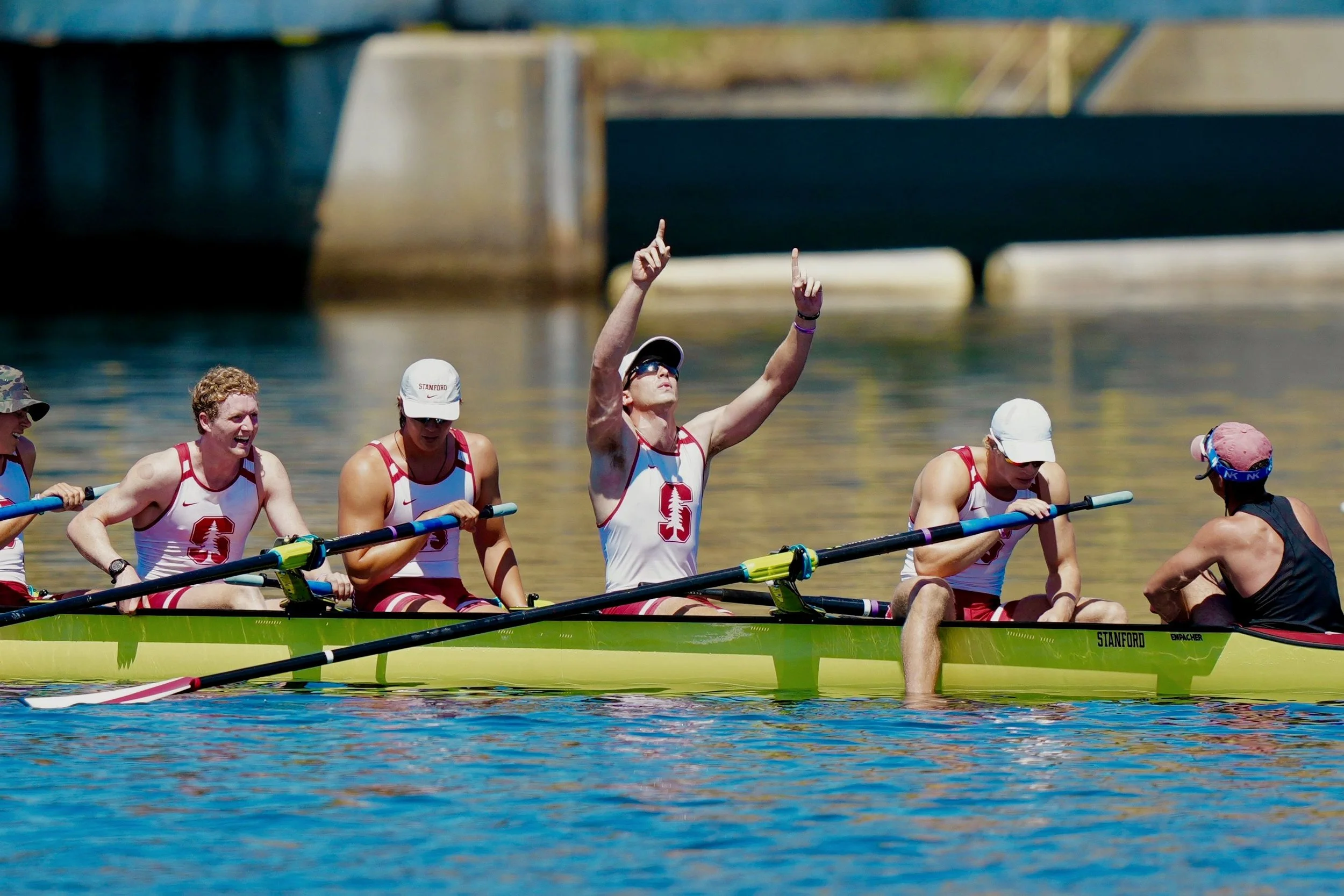
The Stanford Men delivered the kind of IRA weekend the program has been building toward. Stanford finished fifth in the Ten Eyck standings with 209 points, tying the program’s best team finish from 2009, and won the Clayton Chapman Trophy as the most improved men’s team after jumping 61 points from last year’s total of 148. The 1V8 made the Grand Final and finished sixth, the 2V8 won the Petite Final to take seventh overall, and the 3V8 finished 11th after placing fifth in its B final. That was enough to beat the pre-championship No. 8 Ten Eyck projection and finish just one spot behind Cal in the overall team standings.
What made the result especially impressive was the context. Stanford remains one of the youngest average-age heavyweight programs in the country, still feeling the effects of two recruiting classes that were disrupted during the COVID budget crisis. Stanford also approached IRA season with injuries that required meaningful lineup adjustments across the top boats. That kind of shuffling would have been difficult for any team, and it likely hit the 3V8 hardest because it bore the brunt of the chemistry changes required across the fleet. Even with that, Stanford still produced its best overall IRA result in years.
The coaches’ notes from the course captured the feel of it well: this was not just a good regatta result, but the clearest sign in years that Stanford men’s rowing is reshaping its identity. For decades, the IRA Grand Final has been guarded by a select tier of Eastern powers and perennial West Coast giants. Breaking into that circle takes more than one good lineup. It takes total-team belief, patient culture-building, and the willingness to do punishing anonymous work for a long time before the payoff comes. At Lake Natoma, Stanford did not just ask for a seat at that table — it earned one.
That broader identity was also tied to what the team has called “Racing with Abandon” — competing with complete freedom, intensely focused and yet free from fear or apprehension. By May, the Cardinal had developed the kind of depth the program had not shown in nearly twenty years, with the 1V8, 2V8, and 3V8 all pushing each other hard enough in training that the internal standard rose across the team.
The raw improvement over 2025 was real across the board. Last season, Stanford finished ninth in the 1V8, eighth in the 2V8, and 12th in the Ten Eyck standings with 148 points. This year the Cardinal improved to sixth in the 1V8, seventh in the 2V8, 11th in the 3V8, and fifth in the team standings with 209 points. Just as importantly, this year’s fifth-place Ten Eyck finish was built on depth rather than a single outlier boat. In 2009 Stanford also finished fifth, but that result leaned heavily on the 1V8. This year’s team felt even stronger top to bottom.
The 1V8 breakthrough was, of course, the headline. Stanford’s 5:49.608 in the A final earned sixth and marked the first time the Cardinal had reached the varsity-eight A final at a full-field IRA since 2009. That alone made it a landmark moment. But the way the team got there mattered too. As Stanford head coach Ted Sobolewski told row2k after the semifinal, “The A Final has been a big goal of ours. It’s been a build. We’ve got a lot of young guys on the team, and I don’t think you can underestimate the experience that’s now necessary to show up in those moments.” He added, “It’s a big moment for our program because they feel like we’ve taken that step now and so next year we’re not talking about being in the A final in the varsity, we’re talking about something more.”
Readers can find that row2k story here.
The 2V8 may have delivered the emotional centerpiece of the weekend. After a strange semifinal sequence that featured an officials’ stoppage around 800 meters because of geese interference in another boat’s lane — and then a full re-row only about 20 minutes later — Stanford came back in the Petite Final from lane 4 and rowed its best race of the year at exactly the right time, winning in 5:51.247 by less than two tenths over Northeastern. On Lake Natoma, lane 4 is not usually where you expect to see the race winner. Stanford made it happen anyway, and in doing so locked down seventh in the nation. That was a real comeback statement.
The 3V8 did not get quite the same finishing headline, but its presence mattered. Stanford had not raced a third eight at IRAs in seven years, and getting one back onto the national stage is itself a sign of roster health and internal competition. The 3V8 bore a lot of the lineup adjustments caused by injuries and movement up the ladder, yet still reached the Petite Final, finished 11th overall, and contributed 42 net-new points in the Ten Eyck standings. That is the kind of result that looks even more valuable when viewed through the lens of long-term program development.
The Chapman Trophy fit the weekend perfectly. In the row2k Sunday feature, Sobolewski said, “The Chapman Award has been on our minds from the beginning of the year. We knew we would have three eights this year, and just by having three eights at the regatta that we would be in a good position. But the guys also came together and made sure we had three eights.” He then added, “There was a whole team effort this year, and it was a driver, for sure, of what we wanted to do here. Make the A Final in the varsity and win the Chapman Award. To do that and to get fifth in the Ten Eyck overall, I couldn’t be prouder of the team.”
Readers can find that row2k story here.
Behind the points were the human elements: the final collegiate rows for seniors Caspar Griffin, James Pullinger, and Jacob Rivera, who weathered the rebuilding years and helped lay the cultural foundation for this moment. They were part of the group that carried the program through the leaner years and helped bring it to this turning point. The underclassmen now carry something even more valuable than a strong result sheet — the experience of having performed on the biggest stage.
Lake Natoma also provided the kind of fair, fast championship conditions that made the racing feel honest. The water was calm, the chop was light, and while a river course can always offer subtle lane differences, this was a much cleaner surface than some recent East Coast championship venues and certainly calmer than what the women faced at NCAAs. It did not guarantee anything, but it made the weekend feel like a true measure of speed.
That is why the 2026 IRA feels like more than a single result. Stanford did not just improve on paper; it looked like a program with growing depth, sharper internal standards, and a young core maturing together. The confidence now looks different too — quieter, steadier, and more earned. More than anything, it looked like a team that has learned to look across a six-boat field and quietly say: you are going to need to race us today.
Stanford Men IRA Finals Results
1V8 (Grand Final)
Washington – 5:37.49
California – 5:38.552
Princeton – 5:40.230
Harvard – 5:41.588
Dartmouth – 5:47.143
Stanford – 5:49.608
2V8 (Petite Final)
Stanford – 5:51.247
Northeastern – 5:51.422
Yale – 5:53.262
Penn – 5:54.200
Cornell – 5:54.885
Dartmouth – 6:01.372
3V8 (Petite Final)
Dartmouth – 5:52.352
Penn – 5:54.644
Boston U. – 5:54.900
Syracuse – 5:55.864
Stanford – 5:57.765
Northeastern – 5:58.004
Ten Eyck Trophy
Washington – 284
Princeton – 272
Harvard – 262
California – 258
Stanford – 209
Read the GoStanford writeup here:
GO STANFORD ROWING!!!