STANFORD ALUMNI IN NEW ENGLAND
Redwood City’s preeminence as the world’s rowing hub notwithstanding, the eastern seaboard of the United States and New England in particular also turn out to have their own rowing traditions, clubs, and events. A number of former Stanford rowers have ended up settling in Boston and in New England, and The Rowing Association caught up with five of these athletes and asked them how their time at Stanford helped set the course for their lives after Stanford. The Rowing Association talked to Bonnie Baker Pohlig (Women’s Crew, 1992), Zander Packard (Men’s Crew, 1992), Lise Schickel Goddard (Women’s Crew, 1995), Daniel Bergstresser (Men’s Crew, 1995), and Josh Burgel (Men’s Crew, 1995).
What did being at Stanford and rowing for Stanford mean to you?
Baker Pohlig: I knew I wanted to row at Stanford from the first time I visited campus. I fell in love with the laid-back atmosphere, the fun people, and the team vibe. More than anything, though, I loved the amazing women on our team; it was such a fun atmosphere, and JD and Wendy were terrific coaches. To be able to row at a high level while taking interesting and challenging classes was fantastic.
I loved how the team was fiercely competitive, and yet fun-loving and scrappy. We didn’t have funding, so we had to earn money for race trips by organizing Bovine Bingo with a rented cow on a campus field, Erg-a-thons at the Stanford Mall, and collecting tickets at football games (really boring and annoying until we were challenged by game-goers who wanted to see if any of the women could do a pull-up, which, of course, we could). As Coach Wendy Davis loved to say, “It’s not the chariot, but the horses who pull it….”
Packard: Rowing was the core of my Stanford experience, and my teammates became the best group of friends I could ask for. It has been amazing to see how the men's and women's programs have thrived over the last few years, especially after the near-death experiences of the Men’s and Lightweight Women's programs during the pandemic. I'm impressed with how the alums have stepped up over the last five years to secure the future of the programs!
Schickel Goddard: Stanford was my world, my place—I loved those years! An enduring feeling from my time at Stanford was a sense of possibility and the sense that everyone had something useful to contribute.
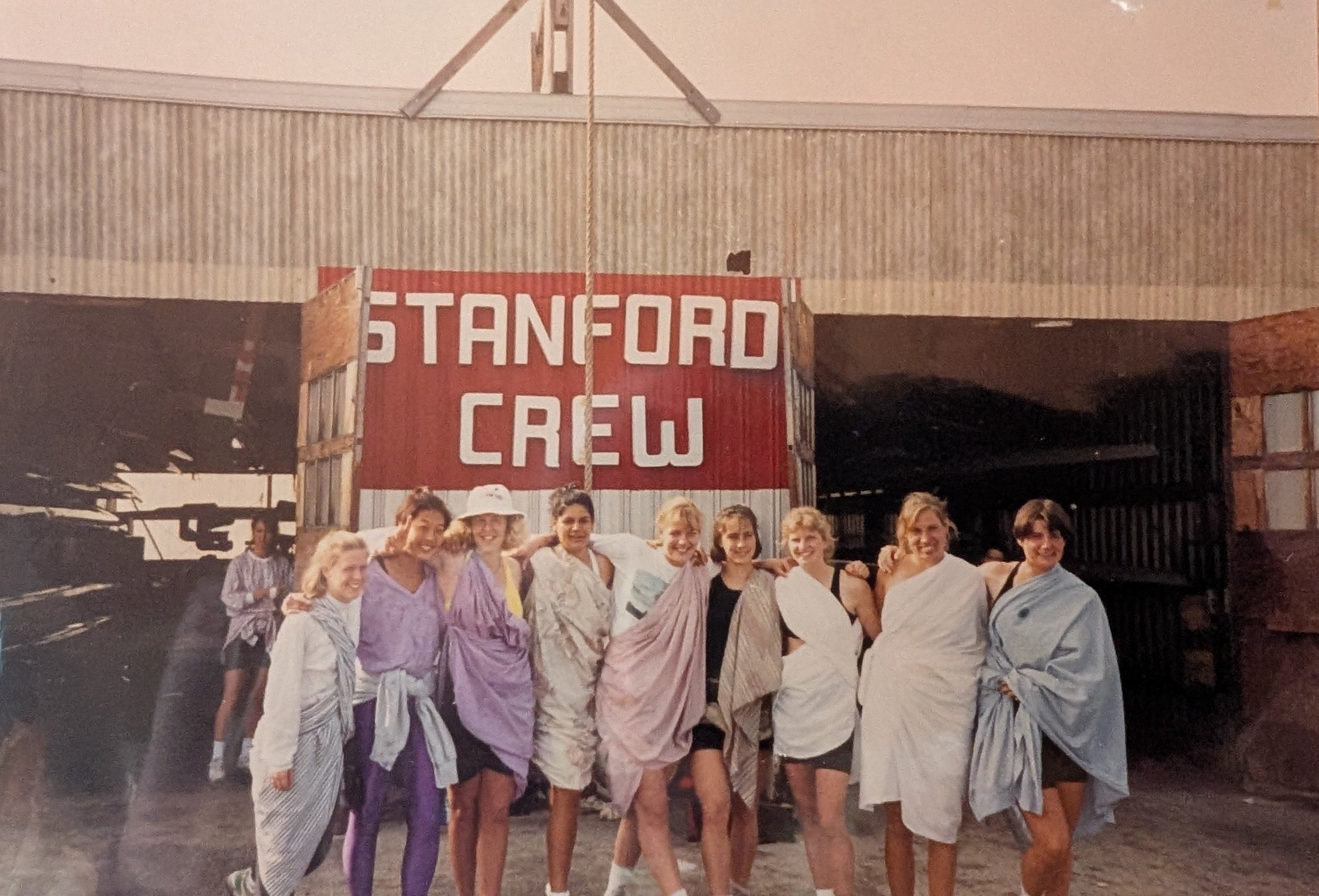
Rowing at Stanford was wildly different in the late '80s and early '90s. We were underdogs and were very underfunded compared to the teams today. Our coaches drove us to practice in an old city bus, past the giant salt pile, to the see-through hut that held our shells. John and Wendy Davis did so much to cultivate a pride in being scrappy and resourceful. This has been an empowering theme throughout my life, working in schools where students and faculty help take care of the place, and take pride in doing so.
As Bonnie said, there were so many lessons we internalized from the Davises: "It ain't the chariot, but the horses that pull it." Wendy was a really encouraging influence in my life, and it is my great joy that decades later our friendship remains strong, light, and humorous! We can shoot each other a text out of the blue and spark that connection and the laughter across all these years.
My friendships with teammates were also profound and lifelong. These lifelong ties re-emerge and reassure us through the triumphs and challenges we face later in life, with the same strength they had in morning practices. I've told Bonnie a number of times that the reason we were teammates all those years ago was so we could have adventures together in this phase of our lives, like our recent trip to Italy.
Bergstresser: I have always been very grateful for the opportunity to study at Stanford and to be part of the rowing program there. I should note that I was very, very far from being a star rower when I was there.
But the sport and my time at Stanford gave me more than I can ever give back. Rowers tend to be a little different, maybe something like 90 or 95 percent human and maybe like 5 or 10 percent Iditarod sled dog. The relationships I built with teammates at Stanford have been a key part of who I have become. It has been very good for me to be rooted in a group of folks who are also part sled dog.
The 1990s were a different era. We were underfunded, the women more so than the men, and our equipment was unreliable at times. On one trip to Los Angeles, our team bus broke down in the middle of nowhere, with nothing but farms around for miles. We ended up getting rescued by the famous West Coast blues performer Jimmie McCracklin and his band when their tour bus driver saw us sitting by our bus as they drove by. McCracklin and his band gave us a ride to LA in exchange for help setting up for their performance, and a broken-down bus ended up becoming part of one of the best experiences of our lives.
That being said, in 2026 you really can’t run an athletic program at any level relying on traveling blues musicians for rides to races. So it has been really amazing to see how alums have stepped up to help put the programs on more stable financial footing.
Burgel: I love Dan's sled dog metaphor. The people I rowed with at Stanford have become lifelong friends. Wieslaw Kujda’s coaching inspired me to coach. Even before graduating, I started coaching at Junipero Serra Crew and then coached the Stanford freshman team for two years. Since then, I have been continuously coaching soccer, skiing, cycling, and mountain biking. Inspiring athletes to achieve in their sport and teaching other coaches to do the same with their own athletes is very meaningful work for me.
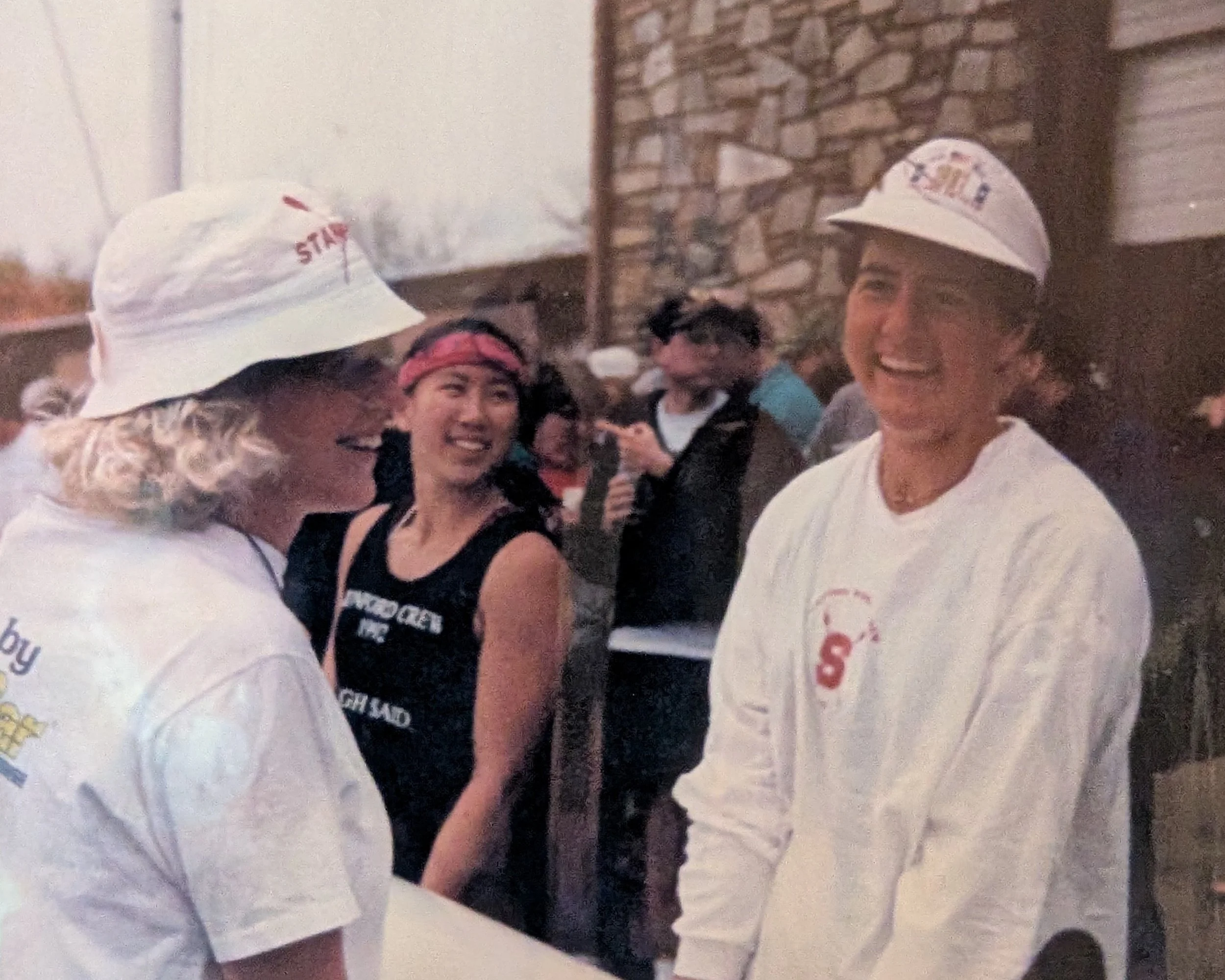
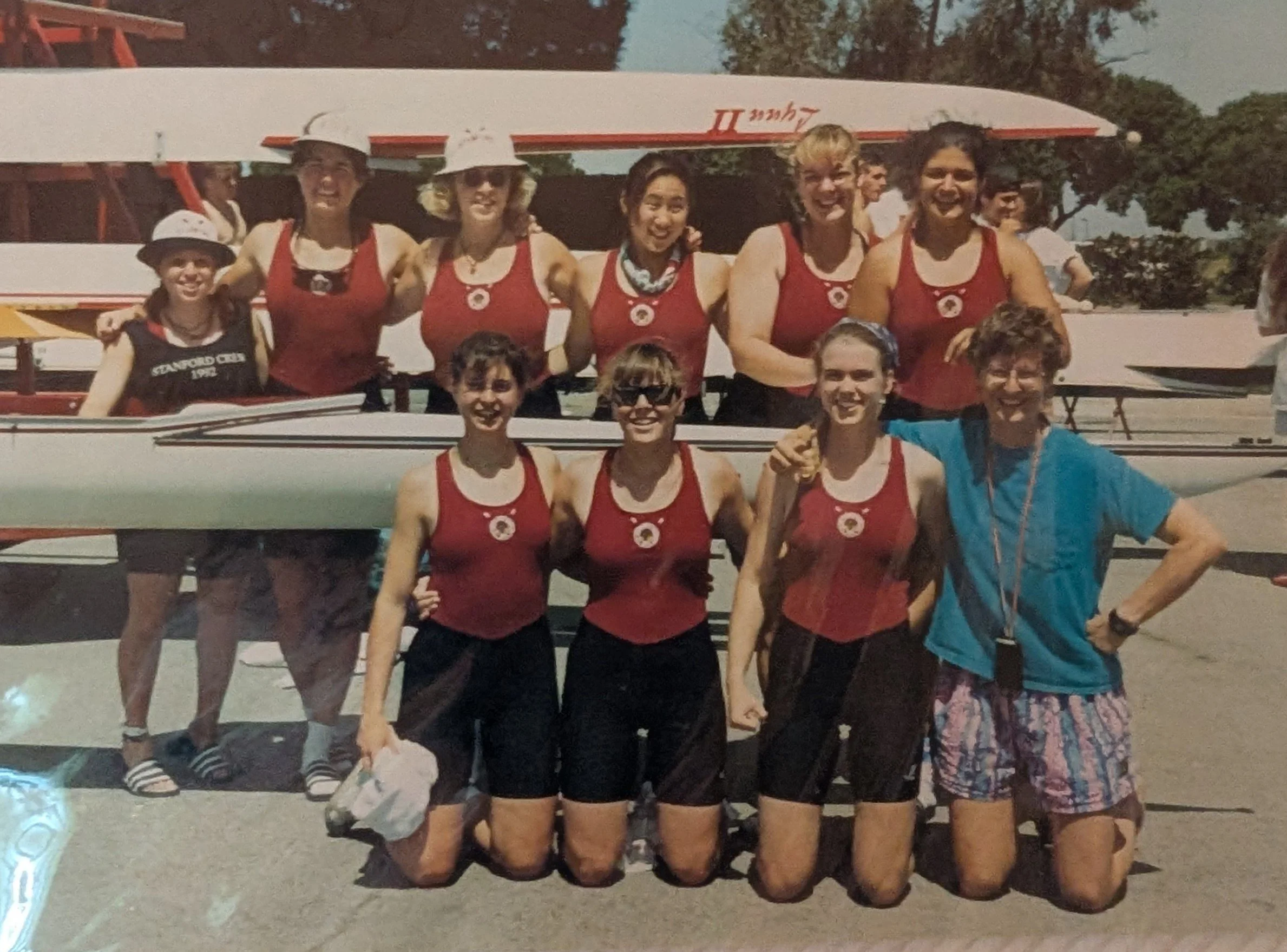
L–R: Lise Schickel, Bonnie Baker, and Chuen-Yen Lau
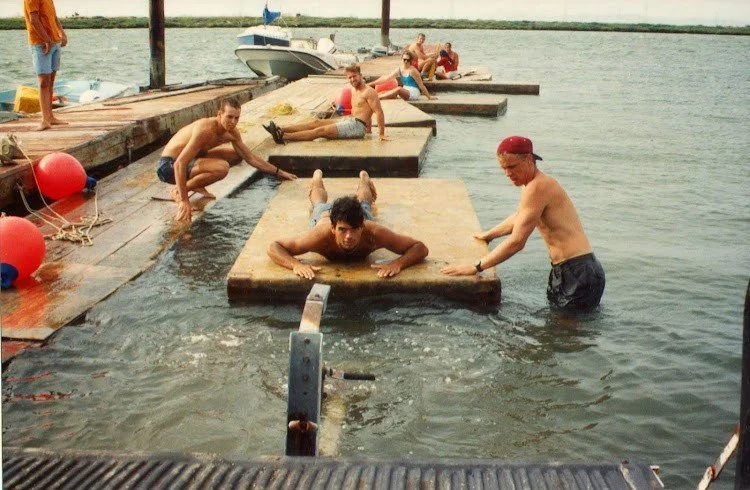
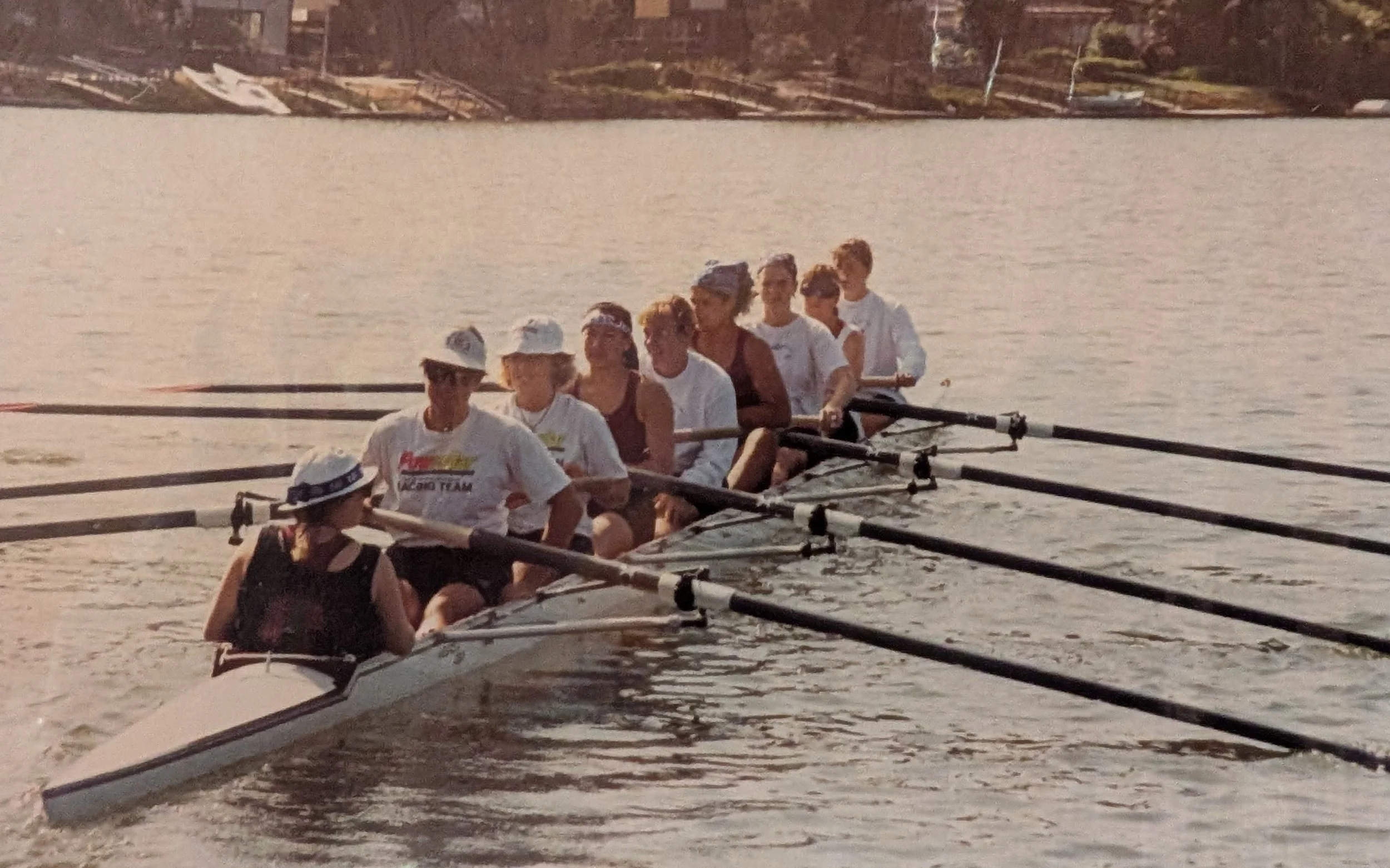
“We are getting the dock pulled up at the end of the 1992 season. The photo captures a bunch of things we all remember: it was hard work, and we were doing it together. The photo also captures some of the personalities of different folks in that gang.
Burgel is up at the front, working hard and productively. Rob Dexter is on the dock piece, guiding it carefully toward the trailer, Rob Bigler is in the water to the right, also doing productive work. In the very back, where things get blurry, wearing red shorts, you see me, doing what I do best, holding down a dock piece. “ — Dan Bergstresser
What brought you to New England?
Baker Pohlig: I grew up in the Boston area, so I returned after college to be closer to family and found work at a product design company. I met my husband at a white-water kayaking class in Concord, Massachusetts, and now live a mile from the pond where we met.
Packard: I went to boarding school in New Hampshire and always loved the seasons in New England. My wife Alison and I moved to the Boston area in 2002, and we decided that it would be a great place to raise our family, which has turned out to be true!
Schickel Goddard: I'm from Ithaca, New York, and big northern lakes are among my favorite landscapes. After college and graduate school at UCSB, I stayed in California, spending seventeen years at Midland School in Santa Barbara County. I worked there as a teacher, director of environmental programs, and dean of students.
Feeling distant from my home landscape and wanting my boys to grow up with their cousins and East Coast family, we bought a small place on Sebago Lake in Maine 20 years ago so that we could spend each summer in this sacred landscape. We moved to Sebago full time in 2020, and we have never looked back. My parents, sister, and her family are close by in Massachusetts.
Bergstresser: I came to New England in 1997 to do a PhD in economics at MIT, and I have been working as a professor since then. My wife, Kim Nicoll, is a Massachusetts native. She didn’t attend Stanford herself, but she spent the summer of 1994 working with some of my Stanford teammates at a YMCA summer camp in Washington, and that is more or less how Kim and I met. I now lead the undergraduate business program at Brandeis University, right on the Charles River.
Burgel: I attended design school at Harvard. In Boston, I met my wife, Kris Scopinich. Kris didn’t attend Stanford herself, but she worked at a YMCA summer camp in Washington where some of my Stanford teammates also worked, and that is more or less how Kris and I met. Kris is originally from Florida; I have nothing against Florida but can’t see myself living there.
Have you continued to be involved with rowing since your time at Stanford?
Baker Pohlig: After 1992, I stopped rowing and didn’t pick it up again until the kids started rowing. Since then, I’ve learned to scull and am now rowing in a women’s sculling group at Community Rowing (CRI) in Boston coached by Kane Larin, the former roommate of Tom Grace (Stanford men’s team, Class of 1993).
Packard: After graduating, I spent three years coaching lightweight men at Georgetown while also rowing and racing at Potomac Boat Club. When we moved to Boston, I joined Cambridge Boat Club, and I got serious about rowing again after our kids started rowing in high school. I ran the Brookline High School Rowing parent organization for several years and have served on the Head of the Charles board for the last three years. It's fun to give back to the sport through thriving clubs, public high school programs, and the HOCR, which is now a must-race event on the international regatta calendar for everyone ages 15 to 90!
Editor's note: Bergstresser came in fifth place in this year’s bike erg sub-competition at the Virtual Head of the Charles.
Schickel Goddard: My first real job after Stanford was teaching biology and coaching rowing at St. Andrew's School in Delaware. In my three years at St. Andrew's, I coached the novice girls, working with head women's coach Brad Bates and helping to build an incredible program. The girls I coached as ninth graders went on to win at Stotesbury, Nationals, and the Henley Royal Regatta in their senior year at St. Andrew's. They were on fire, and they were wonderful people, too!
Bergstresser: I mostly stayed in shape post-graduation because I had a ton of restless energy that had to be burned off somehow. My daughter started rowing in high school, and that was a catalyst for me to get back into boats more seriously and in a more organized way. So I started rowing with the group at Berkshire Community Rowing out in western Massachusetts.
Since then, I have been mostly sculling, and I now scull with a group of rowers out of Community Rowing (CRI) in Boston. We mostly row quadruple sculls and are coached by Kane Larin, also Bonnie’s coach. Sculling is an art, and I consider it a great blessing to have the opportunity to find new things to improve every time I get on the water. My rowing remains something of a work in progress, but Coach Larin is extremely impressed with how much energy I use to move boats through water.
Burgel: Reunion rows are a wonderful way to see how slow we've become, but I would highly recommend a week at a Craftsbury sculling camp. Dan keeps tempting me to get back in a boat, but right now I am fully invested in the bike racing scene here in New England.
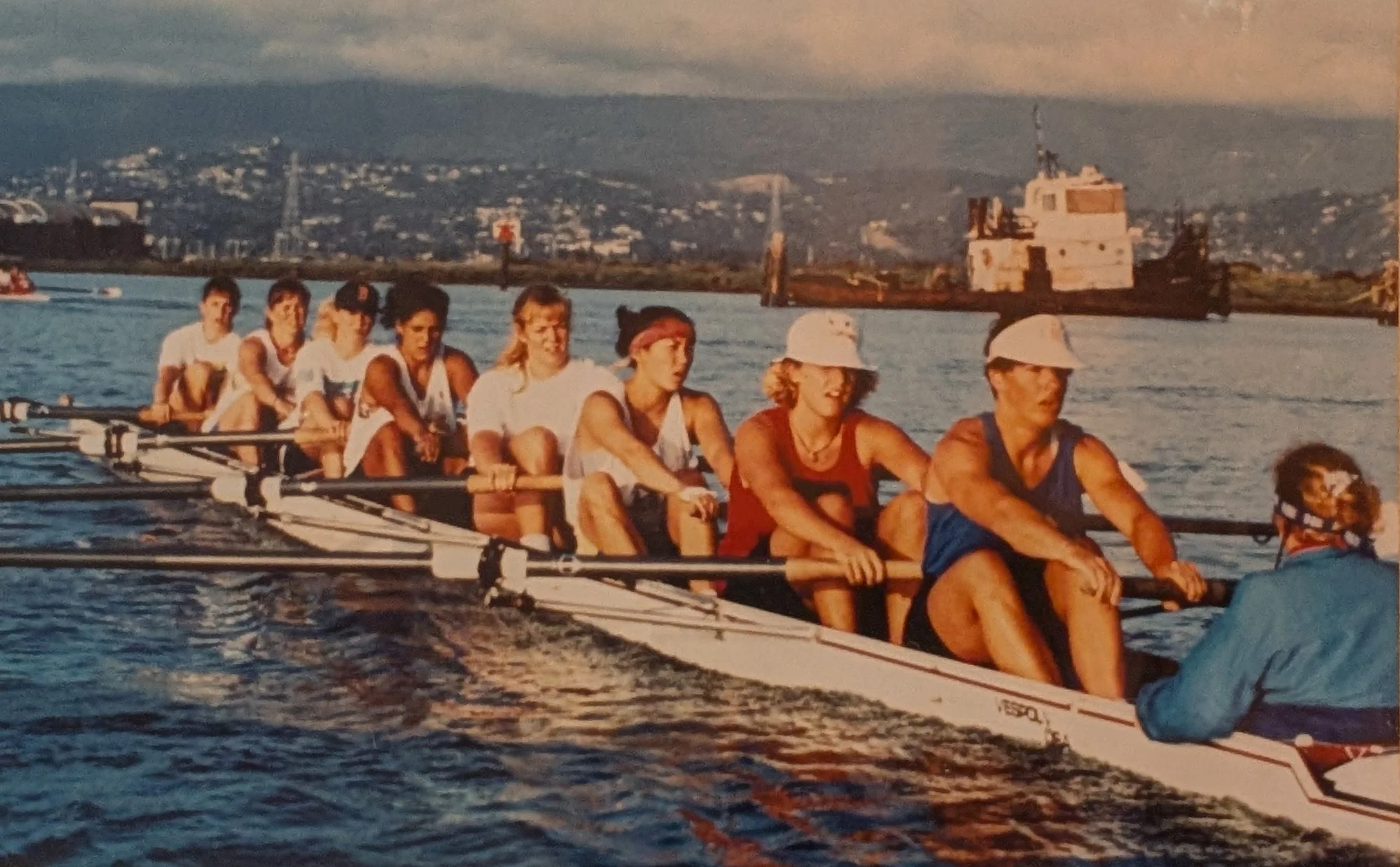
1992 Varsity Women's Eight: Cox: Michelle, Stroke: Bonnie, 7: Lise, 6: Chuen-Yn, 5: Kristen, 4: Claudia, 3: Sarah, 2: Cathy, Bow: Kate
How did your time at Stanford and rowing at Stanford affect the life you've built in New England?
Baker Pohlig: Stanford has this really cool atmosphere of excellence mixed with fun and irreverence that I absolutely love. I fully embraced learning to navigate stressful situations with a smile and a can-do attitude. Some of my closest Stanford friends were on the team, and I cherish those friendships.
Packard: Especially in the cold and gray months of the year, I continue to wonder why we are not living in Palo Alto! I love the continuity of my Stanford friendships and have found it to be a great way to stay in touch with rowing friends. I've raced both with and against Greg Klingsporn (Stanford 1992) many times over the last decade. Greg always wins. I have also supported Jason Stinson's emergence as a Masters rower. I love rowing on the Charles and living in America's best rowing city!
Editor's note: America's best rowing city is actually Redwood City, California.
Schickel Goddard: In addition to the things I've described above, there are at least a couple key ways Stanford rowing has continued to shape me.
As an endurance athlete, I have found a home in walking Caminos across Spain, as well as backpacking parts of the Appalachian Trail closer to home. My first Camino de Santiago in 2023 included the entire Francés route—500 miles—plus much of the Portuguese route in reverse from Santiago de Compostela to Porto.
Last month, I walked the Camino Primitivo—300 miles—and I absolutely loved the mountains and physical challenge. I hope to have many more long walks in the U.S. and Europe in my future.
School leadership has been my wheelhouse throughout my career. I have often said that sitting in the 7 or 8 seat of a racing shell is good preparation for sitting in a dean's seat. My Stanford experiences also helped give me the courage to leave that career in school leadership and pursue my new career as an artist in fabric and stained glass. We built a studio for me in the woods behind our house in Sebago—Striped Maple Studio—and I am immersing myself in a new love and a true calling.
Bergstresser: I'm a professor now, which basically means that I am a coach. Spending the last 30 years trying to get people to learn how to do things has made me much more coachable myself. Rowing is hard, and life can be hard, and teaching people that they can do hard things is very important work. These days, I often take the motivational techniques I learned from my coaches and, to the extent they are appropriate and legal, try to use them with my students.
Burgel: Rowing at Stanford introduced me to the East Coast. I spent a summer rowing at Penn AC in Philadelphia. For folks on the West Coast, Philadelphia is like Boston, but on New York's other side. The people I met there showed me that the East Coast's hard-ass reputation is really just a protective shell wrapping a generous, sincere core.
Do you have kids? Do they row?
Baker Pohlig: My two daughters both row. My eldest, Ellie, learned to row at CRI and just graduated from Colby College, where she rowed all four years. My youngest, Katie, rowed in eighth and ninth grades but decided cross-country skiing was more her style. Each girl has rowed with me in the Parent/Child double scull in the Head of the Charles, and I'm looking forward to hopefully rowing it again with Ellie this October.
Packard: All three of our kids started rowing in high school, and one rowed for a year at Bowdoin College. Our daughter, Avery, represented the United States on the U19 National Team at the Junior World Championships in Paris in 2023 and now rows at Duke University.
Schickel Goddard: I have identical twin boys who graduated in 2025 from Bowdoin and Middlebury. Both became NCAA All-Americans in the mile and established themselves among the greatest distance runners in Bowdoin's and Middlebury's histories. They were also incredible team leaders.
They don’t row, but the bigger bummer to me is that they didn't get into skiing at a young enough age. Now that we're in Maine and I've returned to my childhood love of skiing—with much better skis than we had in the 1980s—I have, at least for now, lost out on the chance to have them as ski buddies.
Bergstresser: My daughter has participated in rowing, equestrian sports, and downhill skiing, the three sports that require the athlete to apply full power with both legs at the same time. She will start college at Georgia Tech next year. My son is a ninth grader who plays basketball and baseball. He is built like a rower, but he can actually jump, so maybe he will make it to the NBA. I am optimistic that even if he makes it to the NBA, he will also eventually start rowing. And if he makes the NBA, he will be able to afford good rowing equipment and boat rack fees.
Burgel: My son Xander is racing bicycles professionally in the U.S. and Europe. You can find him on Instagram at @xanderscopinich. My son Zach is a rising high school senior and competes in cross-country skiing for his high school and for a club that races throughout New England. I think Zach might actually love rowing, but he is an independent kid forging his own path. Perhaps he will walk on to a crew team in college?