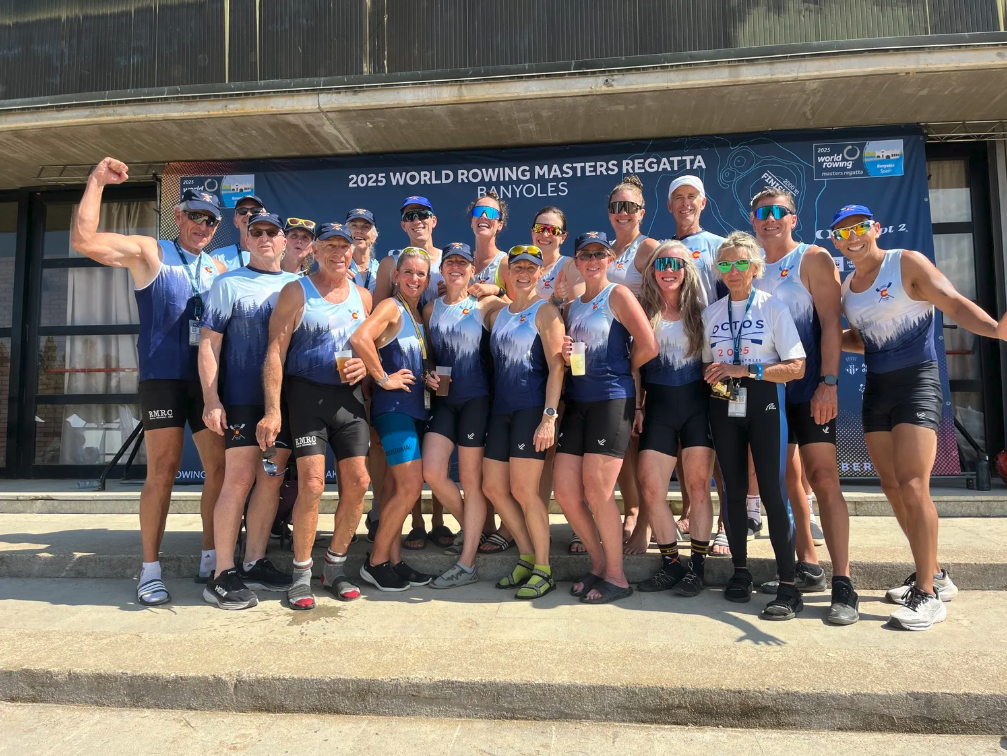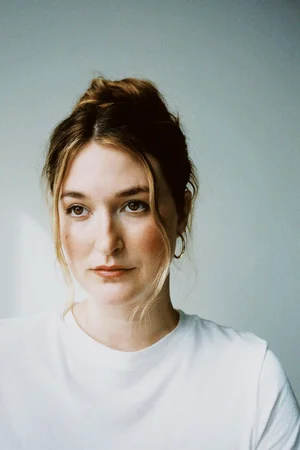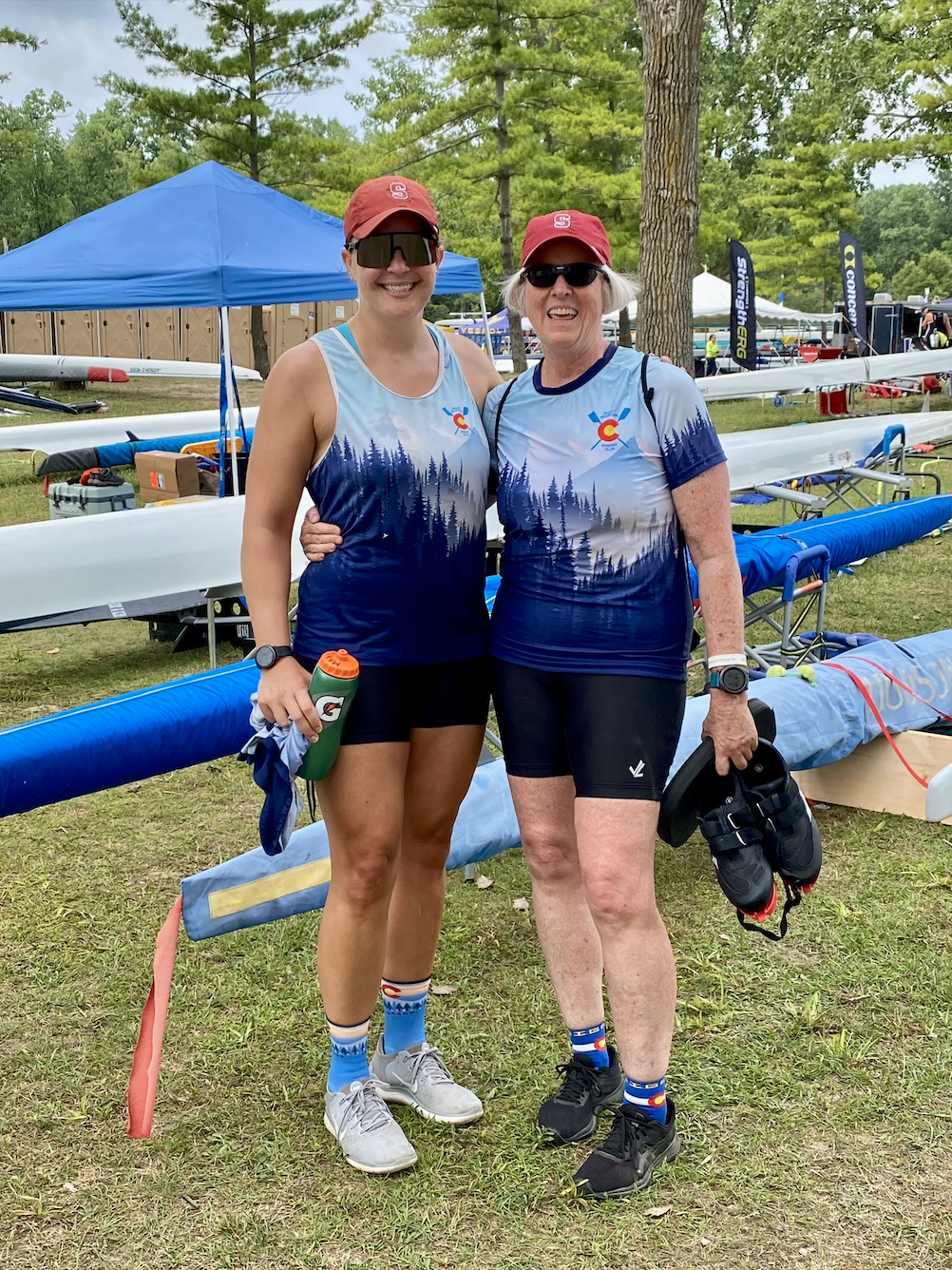
Ann Cuthbertson ‘82 and Erin Manfre ‘12 hadn’t met before being introduced in 2021 through a work connection. Their Stanford WROW histories inspired them to jump in a boat together and see what they could do. Ann, an accomplished Masters sculler, pulled Erin out of “rowing retirement”, and it clicked. They continue to train and compete with Rocky Mountain Rowing Club, and after success in their respective events at the 2025 Worlds, have their eyes on Slovenia this summer.
The Rowing Association recently caught up with Ann and Erin and listened as they shared their Stanford Rowing stories from very different eras.
How did you end up rowing for Stanford?
Ann: I had never even heard of rowing when I arrived at Stanford. This was back in the Stone Age of class registration, where everyone had to go to Maples Pavilion and sign up at long tables. We all came in through the same tunnel. The brand new women’s rowing coach, John Davis, put some tape on one of the tunnel side walls 5’–10” above the floor and then stood opposite. If he saw a woman taller than the tape mark, he would approach with a handshake and a flyer about the rowing program and invite us to an intro meeting on one of the playing fields. I went to the meeting and he had an eight up on slings and some oars. I was curious enough to go to the boathouse later that week. The moment I got in and took the first few strokes, I was hooked! JD told me about the tape trick years later and said the vast majority of women he approached were already spoken for with basketball or volleyball, but he did get enough for a novice 8 where we were all about the same height.
Erin: I learned to row in high school at Westerville Rowing Club — in a suburb of Columbus, OH. As I was looking into college recruiting, I gradually moved my sights from local D2/D3 schools to the Big 10, and then added visits to Washington and Stanford later in the recruiting game. When Vaclav Kacir, the Stanford assistant coach at the time, picked me up from the San Jose airport for my visit, he apologized that the weather wasn't better. It was 75 and sunny. I was sold!
Ann, you were captain in the early days of Stanford Women’s Rowing, what was it like walking in as a freshman as the program was just getting ramped up?
Ann: Women’s rowing was very much under the radar of the Athletic Department. They let us use the varsity weight room (during off hours) and we had access to AD staff physical therapists for injury rehab. But we had to raise all our money ourselves for paying our coach, travel, etc. and we rowed that first year in cast-off boats and oars from the men’s program. The AD gave us a very small stipend in return for cleaning the football stadium after home games which was truly nasty work. Other fund-raising efforts included hosting movie nights on campus and (my personal favorite) Bovine Bingo! The way this worked was we used string to make a matrix of squares in a field, each with a number associated with it. Then we rented a cow and the farmer put her out in the field. People would place bets at $10 a pop on which square the cow would eventually poop and I think the winner got something like $500. The first year the cow wandered around for a long time and then took a nap, so most of the spectators lost interest and left before she finally did her job. The second year the farmer (embarrassed by the long wait) gave the poor cow a laxative and she barely had time to get onto the field before performing! Then we were asked to stop by the AD, who thought that this event was not quite up to the Stanford brand, if you can believe it.
As far as the actual rowing/racing, John Davis was an excellent coach and trainer. We worked hard and had to put up with pretty obnoxious misogyny and resentment from some of the oarsmen. Until we started winning races—that did a lot to shut up the skeptics. By the time I was captain my senior year, the men’s team were on board and some of their alumni became big fans.
Erin, you walked into the Stanford Boathouse when the Program had established itself as a consistent national contender, and was consistently developing Olympic rowers. What was that like?
Erin: The culture of high expectations was well-established. On the walls of the boathouse were pictures of Stanford Olympians past and present. I was in the same incoming class as Lindsay Meyer, who had just deferred her admission by a year to race in the Womens 4x in Beijing. Elle Logan was also returning from Beijing with a gold medal in the Women's 8+. Every summer we had girls on U-23 teams racing internationally. So the bar was high! Yaz Farooq, also an Olympian, was our head coach at the time. So it was just baked into the team culture that we were expected to show up every day working toward the podium.
The year before I arrived, Stanford's 1V8 had been invited at large to NCAA's (they still included individual 1V8+s in addition to the team bids at that time). They placed second in the grand final, and it lit a fire under the entire team to get a full bid in 2009. Not only did we get that 2009 bid, but we came home with the team NCAA championship title (the first in program history)!
How did the two of you, graduating 30 years apart, end up together rowing as “ Stanford?”
Ann: In a very small world moment, Erin got a job working with my little sister a few years ago and mentioned to her that she wanted to get back into rowing. My sister made the online introductions and I roped Erin into our local Masters club, then rather immediately drafted her into coming to Nationals with our squad. We thought it would be fun to race a double together—I think that first year we raced as a C boat.
Erin: Like Ann described, I started working with Ann's sister in 2021 (she was my manager). In our first 1-on-1 meeting together, she said something along the lines of "My sister rows at this club in Denver… you may have heard of her, she's kind of a big deal"… and then "Can I give her your number? She's gonna f**ing love you". Before I knew it, after about a 10 year hiatus, I was racing again!
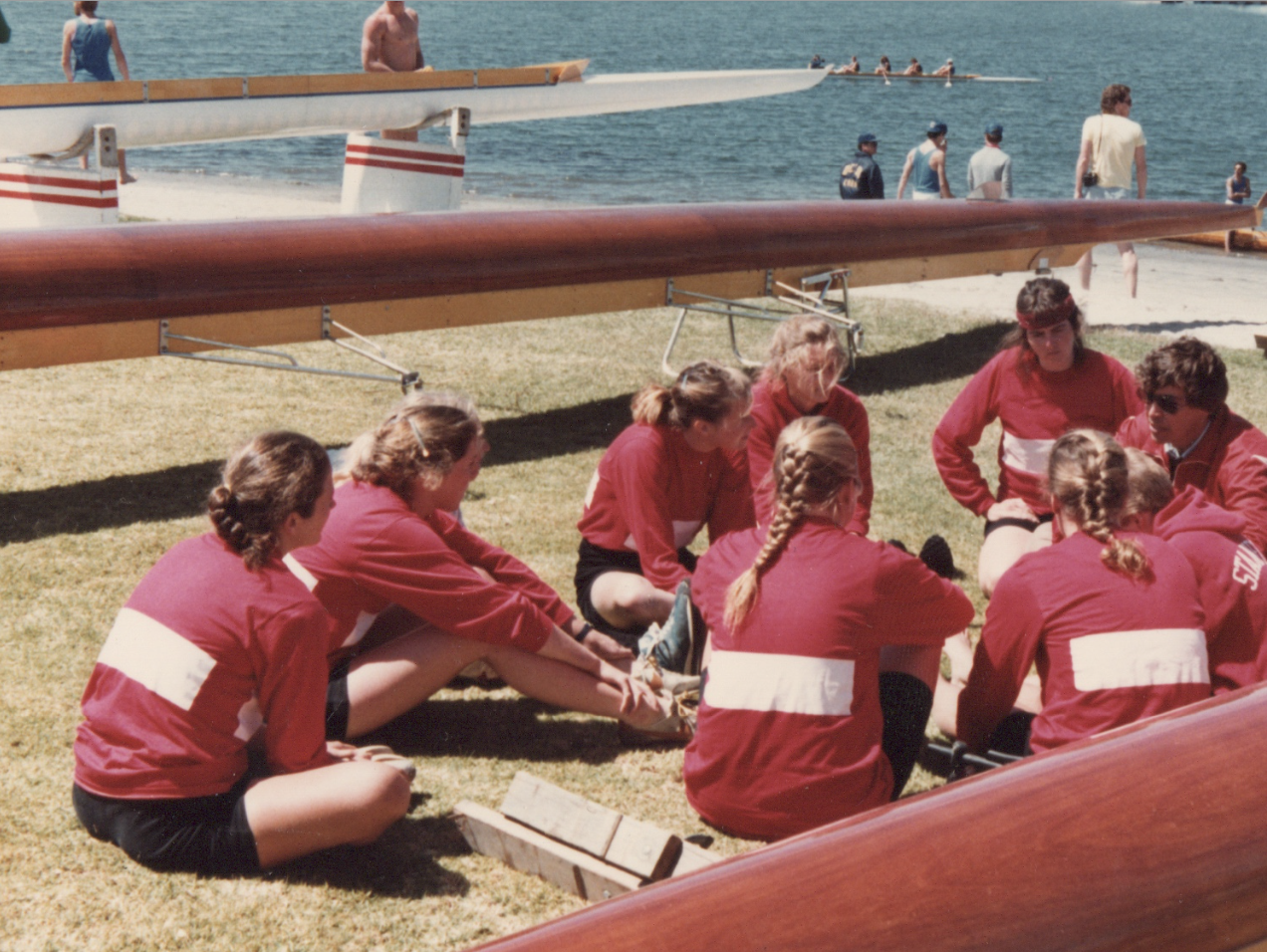
Clockwise: Coach: JD, Kathryn Mills, Jocelyn Kearing McCandless, Jenny Ruckelshaus, Margi Fetter Graham, Kim Hughes, Ann Boss Sheffels, Danilyn Rutherford, Martha Hoffman Kaufman, Ann Cuthbertson
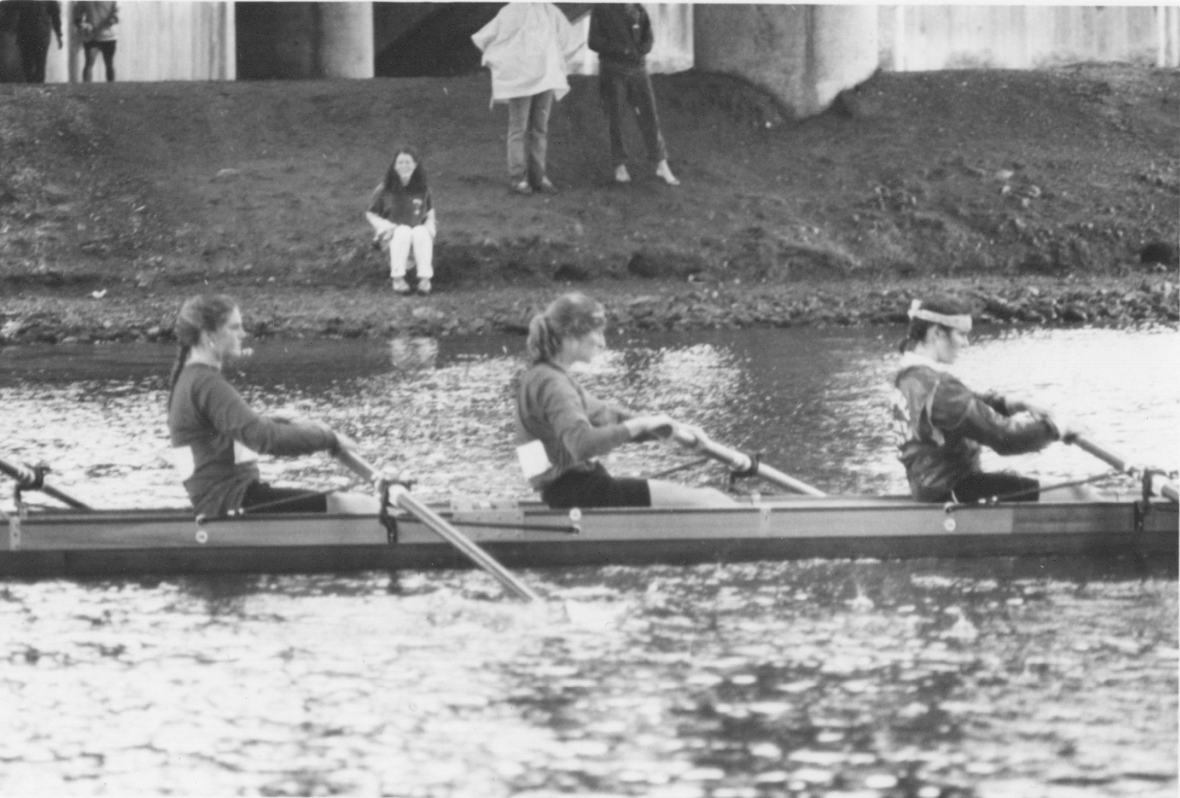
Stroke: Ann Cuthbertson, 7-Heather Cook Lindquist, 6-Jenny Ruckelshaus
Tell us about your current training regimen? Do you get a lot of time on the water?
Ann: Erin’s schedule is probably even crazier, but I row (or in the winter erg) 5–6 days a week, lift 3 times/week, and do Pilates 1–2 times/week.
Erin: Leading up to Masters Nationals and World Masters, I'm typically on the water 6 or 7 sessions per week. I like to mix it up by adding in Orangetheory, some lifting, jogging, or hiking. We're usually on the water from late March through mid-November. But if you're willing to wet launch in 45 degree water, you can squeeze a couple more weeks out at the end of the year!
Is Masters racing more “ fun” than collegiate racing?
Ann: They are both fun! But I do really enjoy mixed racing sometimes and racing with the young-uns like Erin!
Erin: What's really fun is only racing 1k! And the post-race beers.
In all seriousness — the best part about collegiate rowing for me beyond the high level of competition was the camaraderie. My Stanford rowing teammates to this day are still some of my closest lifelong friends. I came into Masters rowing with the mindset of "nothing will ever compare to my experience in college rowing" — but I've actually found that Masters rowing breeds close connections in a very similar way. It's not as intense of an environment, but we still spend a lot of time together, do hard things together, and have a blast! I've grown really close with a group of women at Rocky Mountain, and I'm so thankful for those relationships.
What’s your favorite story from Stanford Rowing?
Ann: Beating Cal for the first time ranks up there for me.
Erin: My freshman through junior years, I was in the 2V8+. We had the typical 2V chip-on-the-shoulder mentality and loved any chance we could take a practice piece from the 1V. In 2009, we placed third at NCAAs. In 2010, we placed second. And in 2011, we won the 2V8+ grand final. Being on that journey of consistently training hard year over year and moving up the podium to secure gold was really special. I have two framed pictures of that 2011 boat in my office today.
What’s your favorite story from Masters rowing?
Erin: Traveling to Banyoles for the World Rowing Masters Regatta last year was incredible. The venue hosted the Olympic rowing events in 1992, and the organizers did a great job incorporating events that honored Olympic rowers who had competed there, as well as celebrating the Catalonian culture of the host city. Getting to travel with teammates, explore the area, and race in such a beautiful place was really memorable. Coming home with a couple gold medals (Ann too!) didn't hurt either. Sights now set on Lake Bled for this summer!
How did rowing influence your Stanford Experience, and does Masters rowing influence your life experience similarly, or differently?
Ann: I made life-long friends with my rowing mates at Stanford. Rowing, and having to juggle one’s schedule to accommodate the time demands of training, taught me discipline and the value of showing up for what matters to me. Those have been invaluable lessons for life and career and readily transferrable to Masters rowing.
Erin: Rowing at Stanford was such a huge part of my day-to-day, it fostered my closest relationships, and it was a key part of my identity in those years (in a good way!). I remember feeling like I already had a built-in family from day one, and I thrived in the structure that twice-daily practices and a rigorous academic schedule created. My freshman year, sitting at the starting line of NCAAs, hearing the announcer get to our lane and call "Stanford” gave me chills — how cool was it that I was representing this powerhouse institution?
Masters rowing has brought a similar influence in the training structure — having a tangible goal to work toward, doing it alongside people who share that goal — it's hard to find outside of team sports in the same way. And it's a fun fact that spurs unexpected connection with others — since I started rowing again (and, of course, talking about rowing more again), I've had numerous people both professionally and socially share that they were rowers once upon a time themselves, or have a close friend or family member who rowed. It's a small world, and it's always fun to find those niche commonalities.
So, we’re caught up on rowing. Fill in a few blanks for us on what else you’ve been doing since leaving Stanford?
Ann: I graduated in 1982, continued training with a group of Berkeley alums for a couple years, then moved to Austin for grad school (architecture). While there I was drafted to coach the fledgling UT women’s rowing program. I moved back to Denver in 1987, worked for an architecture firm for a few years and then went out on my own. I have had my own firm ever since. Married an oarsman from UW whom I met in Austin; we have two grown daughters (taller than me). We now live a charmed life with a dog and two cats and don’t know how to take vacations that are not centered around rowing camps or regattas.
Erin: I graduated in 2012 and then stayed on campus one more year to do the Stanford Teacher Education Program (STEP), graduating with my MA in Education in 2013. I followed a teammate to Denver (shout-out Marielle Higgins, '12) and never left! I taught elementary school for five years and now work as a Product Manager at an education benefits provider (Guild — founded by Stanford alums Rachel Romer and Brittany Stitch). I'm married to a Denver native, Eric, and we enjoy lots of outdoor activities with our two dogs!
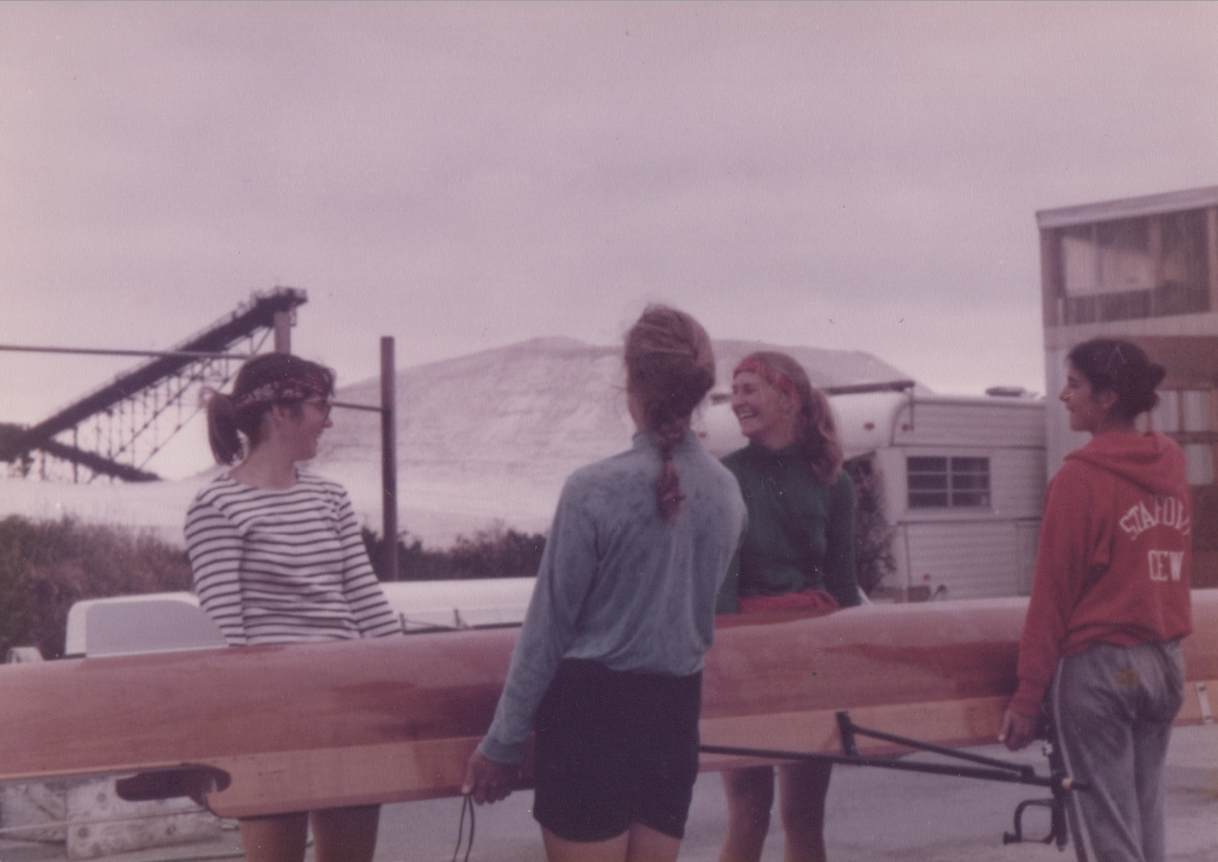
L–R: Ann Cuthbertson, Jocelyn Kearing McCandless, Heather Cook Lindquist