2026 STANFORD MEN SENIOR REFLECTION
Caspar Griffin ‘26, James Pullinger ‘26, and Jacob Rivera ‘26
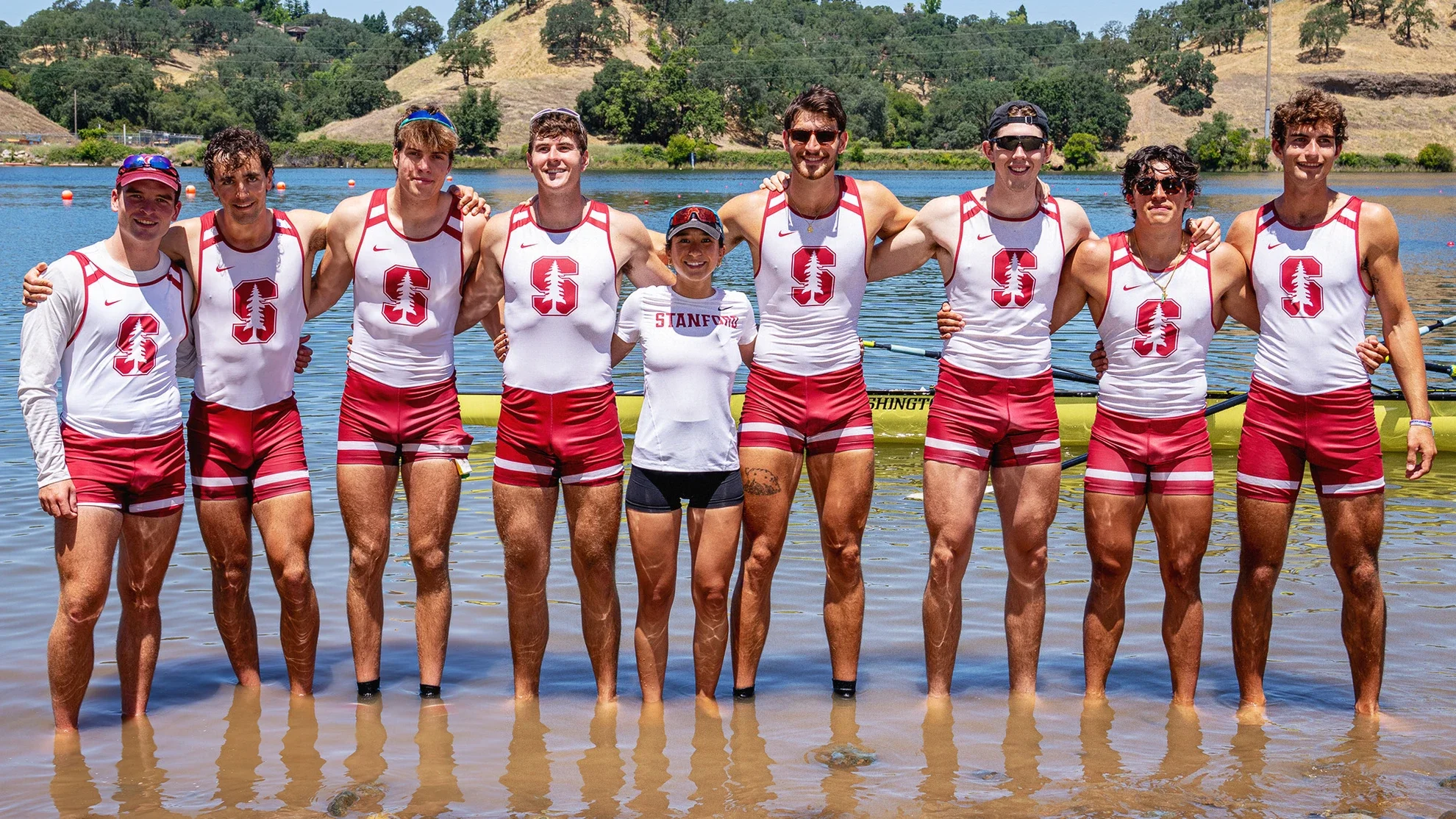
A flurry of thoughts and emotions occupied my mind at the finish line of the IRA championships. Joy, at helping to secure the best placement at the IRA for seventeen years. Amazement, because James Pullinger, in the seat ahead of me, had just unleashed an animalistic sprint. Sadness, with the realization that I would never again get the opportunity to line up with eight of my best friends on a blazing hot day in the Spring to see what we could do. Paddling in, between spotting family, friends, and teammates, I thought of one quote in particular, from a speech by Kurt Vonnegut: “if this isn’t nice, what is?”
I want to explain what “nice” meant in that moment, because it did not necessarily mean “easy.” Part of our four years at Stanford involved navigating our way through difficulties of different kinds: the occasional disappointing result, physical setback, or lesson on what it takes to operate as a high-level team. These moments were an important part of how rowing at Stanford helped to form us as people, confident in our ability to face challenges head-on. “Nice” does not translate to “comfortable,” even if splashing around in Lake Natoma was rather pleasant. “Nice” — at least, as Vonnegut terms it — means something more significant than that. First, a sense of deep satisfaction in our work. It is often remarked that rowing rewards effort, and I’m proud to say that our class has embraced that aspect of the sport. When someone asks me about rowing at Stanford, I think first of the grittiest, raciest days on the port — the days when James goes again and again and Jacob shouts “bowball” from six seats down. Our team has come to embrace the grit and relentlessness required of a top collegiate program. Dedication through the uncertainty made each race mean something. We are hopeful, also, that future generations of SMC rowers will carry with them an understanding of the effort that delivers outcomes.
“Nice” was also only possible because we were in it together, a squad with bonds that extended well beyond any individual boat. Rowing at Stanford meant realizing how much the sport is about building each other up: helping each other through difficult moments, finding reasons to laugh even in the hardest weeks, pushing each other through competition, and learning to race as a unit. If there is something we would like to be remembered for as a class, it is helping the team to understand that rowing means far more than the satisfaction of individual results. It is the feeling of contributing to something much greater than yourself. We depended on each other, of course, but we also benefitted enormously from a whole network of support. We owe a great deal to many people. To the parents, first coaches, Michaela, and Gabby, who made everything possible. To The Rowing Association, whose support has set this program on a trajectory towards the summit of the sport. That goal is in reach. Above all, we must thank the coaches, who have shaped this program into one in which the utmost levels of achievement are possible, founded in trust and conviction in the meaning of Stanford Men’s Rowing.
At the finish line of the IRA, it was clear that we had come to the end of something incredible: exhausting, invigorating, years of effort concluded in a minutes-long race. It was the product of a whole network of people, stretching out far beyond us. It was the product of effort held together by trust. It was the feeling of a well-earned on-shore ice cream, celebrating with our teammates and lifelong friends.
If this isn’t nice, what is?